
USDA Loans in Madison County: Do You Qualify? (2026 Realtor Guide)
Written by Jon Smith, local Huntsville Realtor — April 2026
If you're shopping for a home in Madison County, AL, and your target neighborhood is Harvest, Meridianville, Hazel Green, parts of Owens Cross Roads, Toney, Gurley, New Market, or other areas outside the Huntsville and Madison city limits, there's an excellent chance you qualify for a USDA Rural Development loan — and most relocators don't realize it. The USDA loan offers 0% down payment, lower mortgage insurance than FHA, and competitive rates, making it the second-best loan type after a VA loan for eligible buyers. Yet most Huntsville-area buyers I work with assume they don't qualify because the word "rural" makes them think of cornfields.
The reality: the USDA "rural" map covers most of Madison County outside the Huntsville/Madison city limits, and the income limits are generous enough that most middle-class households qualify.
Set up free MLS listing alerts filtered by your price range and target areas.
What is a USDA loan?
The USDA Rural Development "Single Family Housing Guaranteed Loan Program" (USDA loan, for short) is a federal mortgage program designed to encourage homeownership in rural and small-town areas. The loan is originated by a regular lender (not the USDA itself), but is backed by a USDA guarantee similar to how the VA backs VA loans. Key features:
- 0% down payment required — same as a VA loan
- Lower mortgage insurance than FHA (typically 0.35% annual vs. 0.55% for FHA)
- Competitive interest rates — typically equivalent to FHA rates, slightly above VA rates
- 30-year fixed-rate standard
- No prepayment penalty
For eligible buyers, USDA is meaningfully cheaper than FHA over the life of the loan due to the lower mortgage insurance.
The two USDA eligibility tests
There are two separate eligibility checks for a USDA loan, and you must pass both:
Test 1: Property location
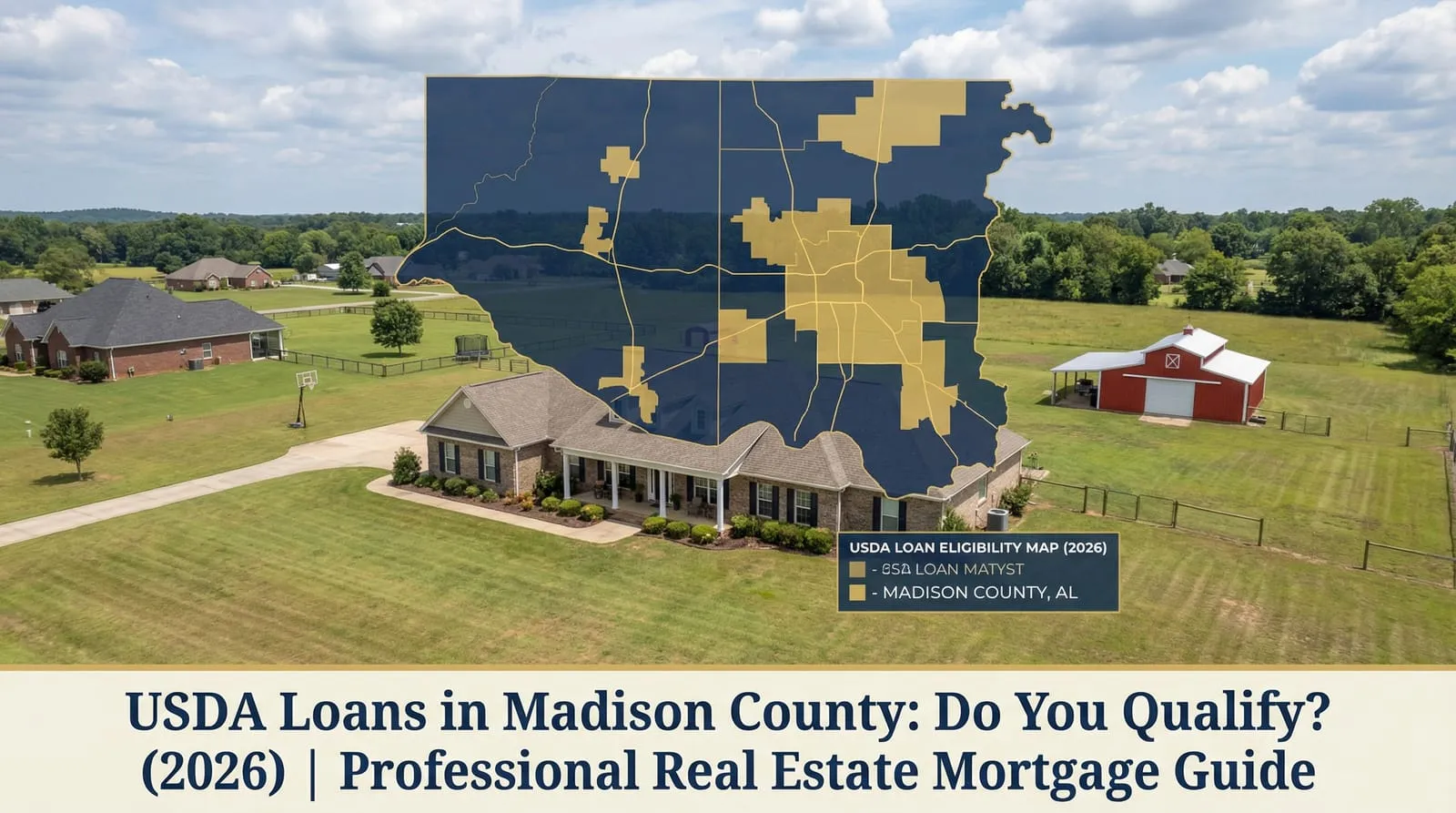
The property must be located in a USDA-eligible area, defined by the USDA Rural Development Property Eligibility map. The map is more generous than the word "rural" suggests — it covers most of Madison County outside the incorporated city limits of Huntsville and Madison.
USDA-eligible areas in Madison County (typical 2026):
- Harvest — almost the entire community
- Meridianville — entire community
- Hazel Green — entire community
- Toney — entire community
- New Market — entire community
- Gurley — entire community
- Outer Owens Cross Roads — most areas outside the small incorporated city center
- Outer Hampton Cove — some perimeter areas (verify by exact address)
- Western Madison County — most areas west of Madison city limits
- Northern Limestone County (Athens area) — many neighborhoods
NOT USDA-eligible:
- City of Huntsville — almost all of it
- City of Madison — almost all of it
- Incorporated portions of Owens Cross Roads — verify by address
- Some recently-annexed areas — verify by address
Always verify the exact address. The USDA map runs through neighborhoods in ways that don't always match subdivision boundaries. Two houses across the street can have different USDA eligibility. Use the official USDA eligibility map (USDA Rural Development website) and enter the exact address.
Test 2: Household income limit
USDA loans have a household income cap (not just borrower income — total household income, including non-borrowing spouses and adult household members). The limit varies by county and household size.
Madison County 2026 typical limits (verify current values with your lender):
- 1–4 person household: approximately $112,000–$118,000
- 5–8 person household: approximately $147,000–$155,000
If your household income is above the limit, you don't qualify regardless of property location. If you're just above the limit, talk to your lender — some deductions (childcare, qualifying medical expenses, dependent deductions) can lower your "adjusted income" enough to qualify.
What USDA loans don't have
The USDA loan is generous, but some misconceptions are common. Things USDA loans don't offer:
- No 0% down on luxury homes. USDA limits are based on household income; it's a moderate-income program.
- No investment property purchases. Like all government loan programs, owner-occupancy is required.
- No second homes. Primary residence only.
- No "USDA grant." USDA is a loan, not a grant. There is no free money component.
- No fast closings. USDA loans typically take 35–55 days to close vs. 25–35 for conventional/VA. The USDA underwriting step adds time.
A real client story
I worked with a couple in 2025 — both 29, husband a Mazda Toyota Manufacturing Alabama production engineer, wife a kindergarten teacher in Madison County. Combined household income $94,000. They had $8,000 saved.
They came in convinced they needed FHA (3.5% down) and were shopping in the $220,000–$240,000 range, frustrated that everything in Harvest seemed slightly out of reach. We checked USDA eligibility for their target Harvest neighborhoods — eligible. We checked the income limit for their household size (3 people including a 2-year-old) — under the limit by ~$15K.
We restructured as a USDA loan. They closed on a 4-bed / 2.5-bath, 2,150 sq ft new construction Harvest home at $284,000 with 0% down. Total out of pocket at closing: approximately $2,400 (mostly inspection, appraisal, and a small earnest money difference). Their PITI+H is $2,180/month — meaningfully lower than the same purchase with FHA would have been because of USDA's lower mortgage insurance.
Compared to their original FHA plan at $235,000: - $49,000 more home (extra bedroom, bigger lot, newer construction) - $0 down vs. $8,225 down (kept their savings as a cushion) - ~$70/month lower mortgage insurance
His honest summary at the 6-month mark: "I had no idea USDA was even an option for us. I assumed 'rural' meant farm country. We live 10 minutes from a Walmart and 15 minutes from Cummings Research Park. The USDA loan made the house possible."
An original Jon insight: the "USDA closing timeline trap" most buyers don't plan for
Here's something I tell every USDA buyer at the offer table that almost never appears in USDA guides: the USDA loan's slightly slower closing timeline is a real factor when you're competing against other offers in a multi-offer situation, and the smartest USDA buyers structure their offers to neutralize the timing disadvantage.
Most USDA buyers think about the loan in static terms — they qualify, they get pre-approved, they shop. They don't think about how their loan type affects their offer competitiveness when the seller has multiple offers to choose from. The reality:
-
USDA loans take 35–55 days to close vs. 25–35 for conventional or VA. The USDA conditional commitment step adds 7–14 days that conventional loans don't have.
-
Sellers prefer faster closings, all else equal. A seller weighing two equal-price offers — one USDA at 50 days and one conventional at 30 days — almost always picks the faster close.
-
The fix: structure the USDA offer to be slightly more attractive on other dimensions. A USDA offer at $292,000 with stronger terms can beat a conventional offer at $295,000. Your Realtor should be coaching you on the trade-offs.
-
Stretch tactics that level the playing field: offer slightly above asking, increase earnest money, shorten inspection period, waive minor contingencies (NEVER the inspection itself), provide a "lender letter" affirming a tight USDA timeline, offer flexible possession date.
-
The USDA underwriter assignment is a wildcard. Some USDA underwriting offices process faster than others. Ask your lender which USDA office your file will go to and what their current turnaround is. This information can shave 5–10 days from the realistic timeline.
-
Competing in new construction is easier. New construction sellers are typically less time-sensitive than resale sellers. USDA buyers competing for new construction face less timing pressure than USDA buyers competing for resale.
I have watched USDA buyers lose multi-offer situations on identical-price offers because the seller picked the faster-closing buyer. The USDA loan is generous, but you have to negotiate around its closing timeline, not pretend it doesn't matter.
Nobody publishes this. USDA loan guides celebrate the 0% down feature without acknowledging the offer-competitiveness trade-off.
Frequently Asked Questions
Is Harvest, AL eligible for USDA loans? Yes — Harvest is almost entirely USDA-eligible per the current USDA Rural Development map.
Is Madison City eligible for USDA loans? No — the city of Madison is almost entirely outside the USDA eligibility area. A few perimeter addresses may qualify; verify by exact address.
Is Hampton Cove eligible for USDA loans? Most of Hampton Cove is NOT USDA-eligible because it's within Huntsville city limits or annexed areas. Some outer-edge addresses may qualify; verify by exact address.
What's the income limit for USDA loans in Madison County? For a 1–4 person household, approximately $112,000–$118,000 in 2026 (verify current values). Larger households have higher limits.
Do I need to be a first-time buyer for USDA? No — USDA does not require first-time buyer status. Any eligible buyer can use it.
Can I use USDA for new construction? Yes — USDA loans work for both new construction and resale homes, as long as the property meets USDA property standards.
What's the credit score minimum for USDA? Most lenders require 640+. A handful of lenders will go down to 620 with compensating factors.
Why is USDA cheaper than FHA? Lower annual mortgage insurance (0.35% vs. 0.55%) and a lower upfront guarantee fee (1.0% vs. 1.75% for FHA). Over 30 years, the savings add up to many thousands of dollars.
Next step
If you're shopping in Harvest, Meridianville, OCR's outer edges, or anywhere outside the Huntsville/Madison city limits, the most useful steps are: (1) check the USDA Rural Development eligibility map for your target addresses, (2) verify your household income is under the limit, (3) get pre-approved with a USDA-experienced lender, and (4) structure your offers to neutralize the slightly slower closing timeline.
Get USDA-eligible matches delivered the day they hit the market.
Related reading:
- Huntsville, AL Home Buyer's Guide: From Pre-Approval to Closing
- First-Time Home Buyer Programs in Alabama
- VA Loans in Huntsville: The Complete Veteran Buyer's Guide
- Conventional vs. FHA vs. VA: Best Loan for Huntsville Buyers
- Harvest, AL Homes for Sale: Everything You Need to Know
Jon Smith is a licensed Alabama Realtor serving Huntsville, Madison, Hampton Cove, Owens Cross Roads, and the broader Madison County area. USDA program details current as of April 2026; verify current eligibility maps and income limits with your lender. Market data sourced from the Huntsville Area Association of Realtors MLS as of April 2026.