
How Much House Can I Afford in Huntsville on a $100K Salary? (2026 Realtor Math)
Written by Jon Smith, local Huntsville Realtor — April 2026
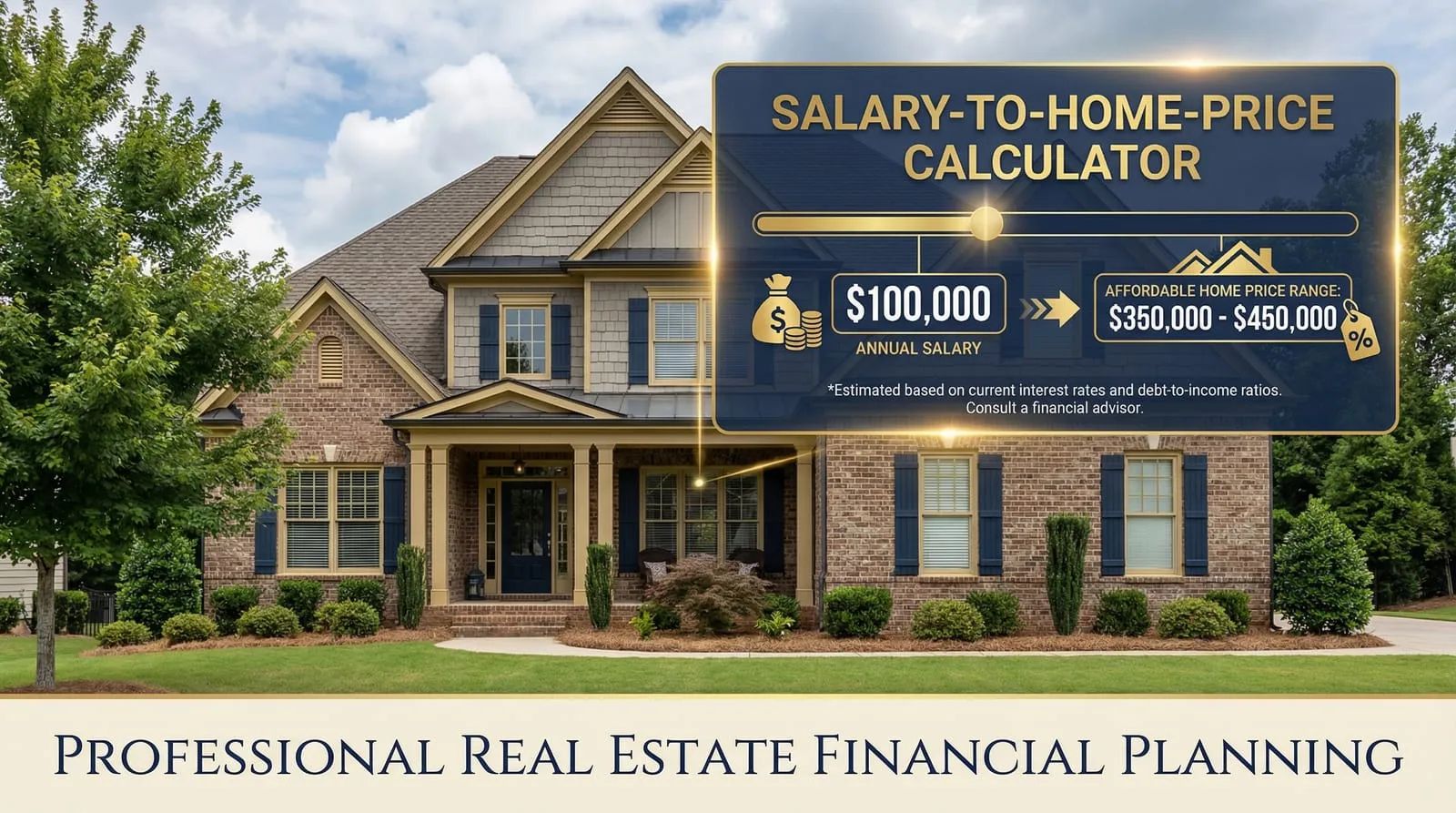
If you're earning $100,000/year and shopping for a home in Huntsville, the answer to "how much house can I afford" is meaningfully different from the answer in Atlanta, Nashville, or any major coastal city — because Huntsville's property tax rates, insurance costs, and HOA fees are all materially lower, which expands what your monthly payment will actually buy. The short answer: a $100K Huntsville earner can typically afford a home in the $325,000–$400,000 range with a moderate down payment, which is meaningfully more house than the same income would buy almost anywhere else in the southeast outside small Alabama and Mississippi metros.
This guide is the local-Realtor breakdown of the actual affordability math for a $100K Huntsville buyer in 2026, the line items that drive it, and the practical adjustments that can stretch your budget without overextending.
Set up free MLS listing alerts filtered by your price range, neighborhood, and bedroom count.
The 28/36 rule, applied to Huntsville
The traditional affordability rule — sometimes called the 28/36 rule — says you should spend no more than 28% of your gross monthly income on housing (PITI: principal, interest, taxes, insurance) and no more than 36% on total debt payments (housing + car + student loans + credit cards + everything else).
For a $100,000/year earner:
- Gross monthly income: $8,333
- 28% of gross (housing cap): $2,333/month
- 36% of gross (total debt cap): $3,000/month
If you have $400/month of car payments and $200/month of student loans (typical for a 30-something professional), you have $400 of "debt headroom" inside the 36% total before housing eats into it. Your effective housing cap stays at $2,333/month.
What $2,333/month actually buys in Huntsville in 2026
Here's where Huntsville's affordability math diverges from major metros. The line items inside that $2,333/month look like:
| Line item | Typical Huntsville 2026 amount |
|---|---|
| Principal + Interest (P&I) | $1,750–$1,850 |
| Property tax (escrowed) | $180–$240 |
| Homeowners insurance | $130–$170 |
| HOA (if applicable) | $30–$80 |
| Total monthly PITI+H | ~$2,200–$2,300 |
Property tax is the biggest line-item difference vs. major metros. Madison County's effective property tax rate is approximately 0.40–0.55% of home value — dramatically lower than Atlanta (1.0–1.2%), Nashville (0.6–0.9%), or coastal metros (1.5–2.5%). For a $350,000 home, that's roughly $1,750–$2,000/year vs. $3,500–$4,200/year in Atlanta. The same $2,333/month buys ~$50,000 more home in Huntsville than in Atlanta purely from the tax differential.
The home price math at $100K income
Working backwards from $1,750–$1,850/month of P&I budget at 7.0% (a representative 2026 mortgage rate) for a 30-year fixed loan, the loan amount that fits is approximately $262,000–$278,000.
| Down payment | Home price you can afford |
|---|---|
| 0% (VA loan) | $260,000–$278,000 |
| 5% conventional | $275,000–$292,000 |
| 10% conventional | $290,000–$309,000 |
| 20% conventional | $325,000–$347,000 |
So a $100K Huntsville earner with 5–10% down can comfortably afford a $290,000 home using the strict 28/36 rule. A 20%-down buyer can stretch to ~$345,000.
Reality check: most lenders will pre-approve well above this. A $100K earner with no other debt can often get pre-approved for $400,000–$425,000 by stretching DTI ratios. Whether you should is a separate question.
What $290,000–$345,000 buys you in Huntsville right now
Per recent HAAR MLS data (early 2026), the $290,000–$345,000 price range in the Huntsville metro typically gets you:
- Madison County (outside city limits): 3–4 bed / 2 bath / 1,800–2,200 sq ft on a 0.25–0.5 acre lot, 5–15 years old. Strong USDA loan eligibility for many of these properties.
- Harvest: 4 bed / 2.5 bath / 2,000–2,400 sq ft new construction or recent build. Madison County School District (Sparkman feeder).
- South Huntsville (Hays Farm, Mountain Gap, Jones Valley): 3 bed / 2 bath / 1,600–2,000 sq ft, 1970s–1990s build, often updated. Strong Huntsville City Schools feeders into Grissom or Huntsville High.
- Madison City: Limited inventory at this price — typically older 3 bed / 2 bath homes around 1,500–1,800 sq ft. Strong school zoning premium.
- Athens (Limestone County): 4 bed / 2.5 bath / 2,000–2,400 sq ft new construction. Lower school rankings but more home for the money.
- Hampton Cove and Owens Cross Roads: Limited inventory at this price — typically the smaller older homes; most Hampton Cove inventory is $400K+.
The affordability stretch tactics
If $290,000 feels too tight for your priorities, here are the legitimate stretch tactics that don't put you in financial trouble:
1. Use a VA loan if eligible. 0% down means your full housing budget goes into principal, plus you save the FHA mortgage insurance. A VA-eligible $100K earner can typically afford $310,000–$325,000 with the same monthly cap.
2. Stack first-time buyer programs. AHFA Step Up + MCC tax credit can lower your effective monthly payment by $150–$250, which translates to $20,000–$35,000 more home affordability.
3. Buy USDA-eligible inventory. USDA loans have lower mortgage insurance than FHA. For Harvest, Meridianville, OCR outer edges, parts of Toney/New Market, this saves $50–$120/month.
4. Negotiate seller-paid closing costs. Asking for $4,000–$7,000 in seller concessions doesn't change your affordability calculation directly, but it preserves your savings for higher down payment or cushion.
5. Buy down the rate. Paying 1 point ($2,000–$3,000) to lower the rate by 0.25% typically pays back in 4–6 years. If you're staying long enough, the savings add up.
6. Choose a lower-tax sub-area. Some Huntsville-area sub-areas have lower millage than others. The right address can save $30–$80/month vs. an otherwise-equivalent address a mile away.
A real client story
I worked with a buyer in early 2026 — a 31-year-old federal civilian software engineer at NASA Marshall, single, $108,000/year, no kids, modest student loans of $260/month, no car payment. He came in convinced he could afford "around $400,000" because that's what an online affordability calculator told him.
We walked through the realistic math: at $108K with $260/month of debt, his strict 28/36 cap was about $2,460/month PITI+H, which mapped to approximately $315,000–$335,000 in actual home price at 7% with 10% down. Above that, he'd be stretching DTI past 36% and reducing monthly cash flow he wanted for retirement savings.
He pivoted his search from $375K–$425K Madison City inventory to $295K–$330K south Huntsville and Jones Valley inventory. He closed on a 3 bed / 2 bath, 1,750 sq ft Jones Valley home at $309,000 with 10% down. His PITI+H is $2,210/month — comfortably under the cap, and his commute to NASA Marshall is 16 minutes via Gate 9.
His honest summary at month 6: "The calculator told me I could afford $400K but it didn't tell me that buying $400K would have meant cutting my 401K contributions by half. The lower price was the right answer."
An original Jon insight: the "lifestyle compression" cost most affordability calculators ignore
Here's something I tell every $100K Huntsville buyer at the loan application table that almost never appears in affordability guides: the marginal $50,000 of home price you can stretch to is almost never worth the lifestyle compression it creates over the next 5 years, because the lifestyle compression compounds in ways the affordability calculator doesn't measure.
Most buyers use affordability calculators to find their maximum price and then anchor on that maximum. The calculator says "$425,000," they shop for $425,000, they buy at $425,000. What the calculator doesn't say is what daily life looks like at the maximum:
-
Reduced retirement savings. Stretching your housing budget by $300/month often means reducing 401K or IRA contributions by $300/month. Over 30 years at typical market returns, that's roughly $350,000–$500,000 of foregone retirement wealth. The marginal $50K of home price costs $400K of retirement wealth.
-
Reduced emergency fund cushion. Buyers at the maximum end of their affordability rarely have 6 months of expenses saved. They have 1–2 months. When the HVAC dies in July, the roof needs work in September, or a job change forces a 2-month gap, the financial stress is meaningfully larger.
-
Reduced discretionary spending recovery time. A trip, a kids' activity, a car repair — at the maximum affordability, every discretionary expense forces a small cash crunch. Over 5 years, this adds friction to almost every "fun" decision and erodes quality of life.
-
Reduced career flexibility. A buyer at maximum affordability is locked into needing their current income level. They can't take a 6-month sabbatical, they can't accept a higher-upside lower-base offer, they can't tolerate a layoff gap. The mortgage becomes a constraint on every career decision.
-
The comparison set is the wrong one. Buyers compare "the $425K house I want" to "the $375K house that fits comfortably." The right comparison is "the $425K house plus 5 years of lifestyle compression" vs. "the $375K house plus 5 years of financial breathing room." The second option almost always wins, but the affordability calculator doesn't show it.
-
The "I'll make more money next year" assumption is unreliable. Most buyers assume their income will rise enough to make the stretch comfortable within 1–2 years. Sometimes it does. Often it doesn't. The right test is whether you can comfortably afford the house at TODAY's income, not at the income you hope to have.
The practical implication: for most $100K Huntsville buyers, the right purchase price is the comfortable number, not the maximum number. If the comfortable number is $310,000 and the maximum number is $400,000, buy at $310,000 and use the difference to build retirement savings, emergency reserves, and lifestyle breathing room. This is the financial decision that compounds in your favor for the next 30 years.
I have watched buyers stretch to maximum affordability and tell me at the 18-month mark, "I should have bought $40,000 less house." I have never had a buyer tell me, "I should have bought $40,000 more house."
Nobody publishes this. Affordability calculators are designed to find your maximum, not your comfortable.
Frequently Asked Questions
Can I afford a $400,000 home on a $100K salary in Huntsville? Possibly, if you have a 20% down payment, no other debt, and a strong credit score. But it stretches the 28/36 rule and reduces your retirement savings capacity. The comfortable price for a $100K Huntsville earner is closer to $290,000–$345,000.
What's the typical mortgage rate in 2026? As of early 2026, 30-year fixed rates for well-qualified buyers are running approximately 6.75–7.25%. VA loan rates are typically 0.25–0.50% lower.
How much do I need for closing costs? Typically 2–3% of the purchase price for buyers in Alabama, before any negotiated seller concessions. For a $300,000 purchase, expect $6,000–$9,000 of closing costs. Seller concessions of $4,000–$7,000 are commonly negotiated and reduce out-of-pocket cost.
Should I buy at my maximum or below it? Almost always below. Buying at maximum reduces retirement savings, emergency fund growth, and quality-of-life flexibility. The financial math heavily favors the comfortable purchase price over the stretch purchase price.
How does property tax work in Huntsville? Madison County's effective property tax rate is approximately 0.40–0.55% of home value annually — dramatically lower than most metros. For a $300,000 home, expect $1,500–$1,750/year in property tax, escrowed into your monthly payment.
Do I really need 20% down? No — most first-time buyers in Huntsville put 0–5% down using VA, USDA, FHA, or AHFA-assisted loans. 20% down avoids mortgage insurance but is rarely necessary or even optimal for first-time buyers.
Next step
If you're shopping for a home in Huntsville on a $100K salary, the most useful steps are: (1) get pre-approved with an AHFA-approved lender, (2) calculate your comfortable price using the 28/36 rule (not your maximum pre-approval), (3) shop at the comfortable price rather than the maximum, and (4) preserve your financial breathing room for retirement, emergencies, and lifestyle quality.
Get matches in your price range delivered the day they hit the market.
Related reading:
- Huntsville, AL Home Buyer's Guide: From Pre-Approval to Closing
- First-Time Home Buyer Programs in Alabama
- VA Loans in Huntsville: The Complete Veteran Buyer's Guide
- Closing Costs for Buyers in Alabama: Full Breakdown
- Should You Buy or Rent in Huntsville Right Now?
Jon Smith is a licensed Alabama Realtor serving Huntsville, Madison, Hampton Cove, Owens Cross Roads, and the broader Madison County area. Mortgage rate and market data sourced from the Huntsville Area Association of Realtors MLS as of April 2026.